Have We Taught Our Children The Wrong Lessons About Grief?


Key Points:

  • Drawing parallels with the character Brian from the book “Hatchet” who, despite his grief, focuses on survival and practical solutions, it is important to support children’s emotional resilience. 

  • Children should not suppress their grief. Instead, they should confront and process their emotions to prevent long-term psychological issues.

  • The Grief Recovery Method is a beneficial program that aids in processing grief, helping children and adults find emotional relief and renewed hope.

In my article about the book  Hatchet , I discussed the impacts of unresolved grief. In addition to the immediate emotional pain, we also find ourselves limited in our ability to experience joy. Our ability to concentrate – or to connect with those around us – is also frequently impacted. We can even find that colors, scents, and everything around is muted.

The good news is that grief recovery is a powerful way of “completing” grief and regaining joy and vibrancy in our lives. I’ve experienced this myself and seen how it’s benefited others I’ve helped.

This personal recovery has been profound. However, there are even more profound reasons to pursue grief recovery:  the impact of adverse experiences on young people.

What are Adverse Childhood Experiences (ACEs)?

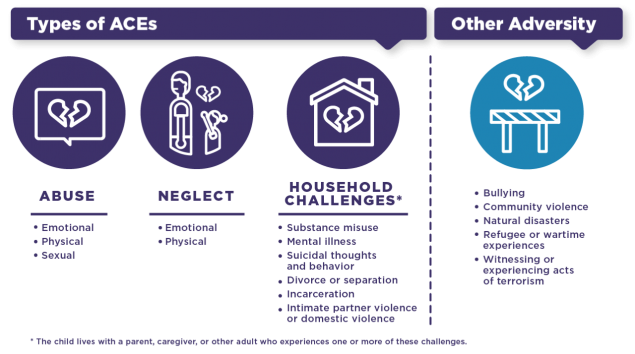
Per Dr. Colleen Bridger, ACEs fall into the following broad categories:

  • abuse  (physical, emotional, and sexual) and/or  neglect  (physical and emotional),
  • and  household dysfunction  (mental illness, mother treated violently, divorce, incarcerated relative, and substance abuse).
Types of ACEs Graphic

(Graphic from  the Center for Disease Control.)

Despite our greatest desires, divorce can have long-lasting impacts on our children.

In studying ACEs, people are asked to consider their life experience and count how many apply to them to determine what their ACE score is.

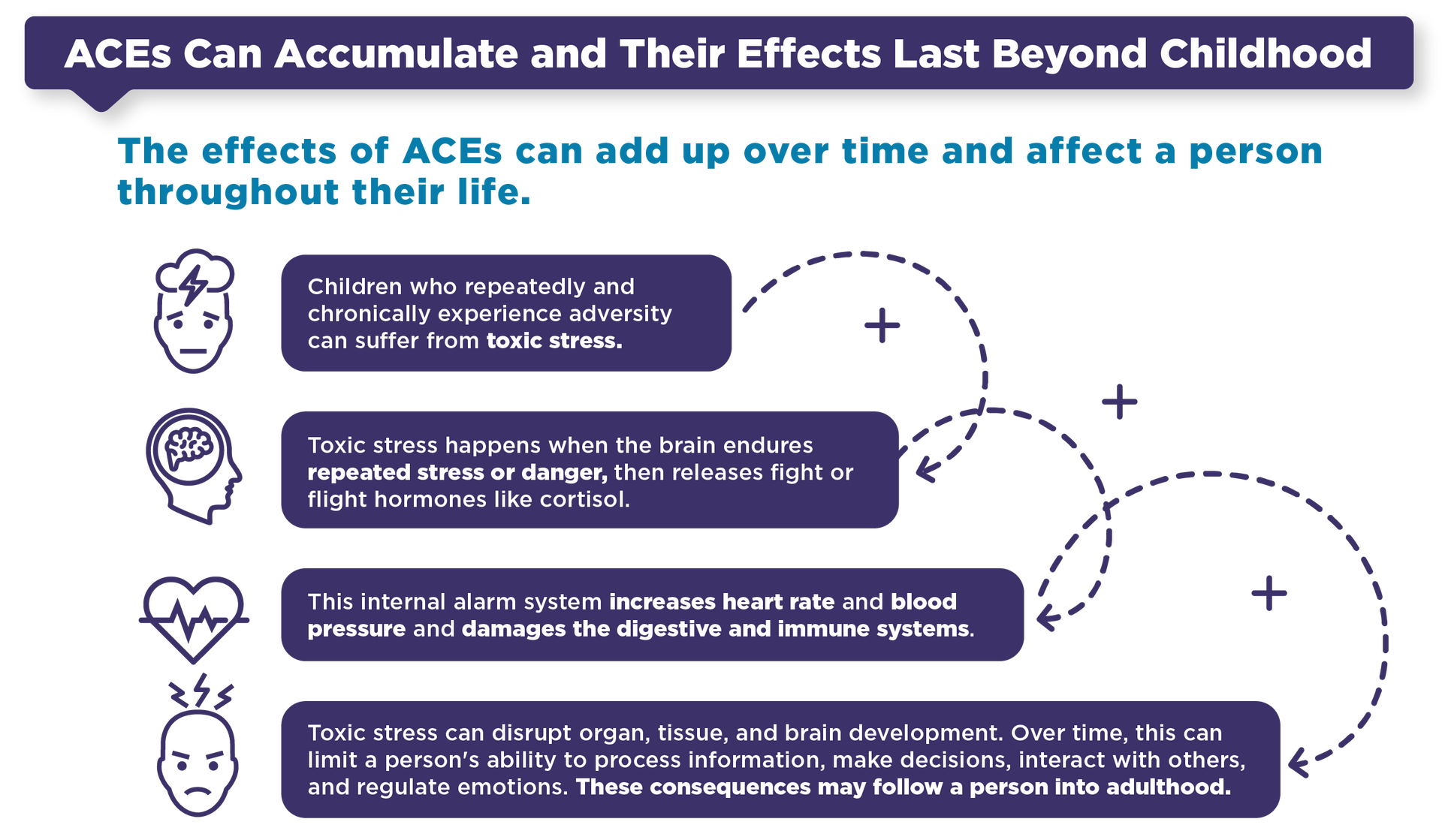
One study found that only 36% of people had zero ACEs, while over 20% had 3 or more. ACEs cause toxic stress in a child’s body, stress that is strong, persistent, prolonged and/or frequent without support from a trusted adult. In the developing mind of a child the toxic stress from having experienced multiple ACEs can cause significant and life-altering damage.

Dr. Bridger explained: “We know that increased stress hormones leads to chronic inflammation. Chronic inflammation leads to chronic disease” ( source ).

Under such heightened stress, the brain is constantly telling the body that it needs to be afraid. As a result, the minds of the children are developing in an environment of ongoing fear and anxiety. As this child develops in these circumstances, they are in search of things that allow them to block or not feel these difficult feelings. This very frequently leads to them engaging in very risky behaviors.

ACEs Graphic

(Graphic from  the Center for Disease Control.)

As more is learned about the effects of ACEs, some schools are training their staff to approach differently students that are acting out. Instead of saying: “What’s wrong with you,” they ask: “What’s happened to you?” This leads to very different types of interventions which often yields much better outcomes for these young people.

There’s more to consider

Dr. Nadine Burke Harris, Surgeon General of California, pediatrician, and stress researcher provided the following graphic in a 2021 written statement. It shows the factors by which a person with at least 4 ACEs are likely to have the 10 leading causes of death in the United States.

ACEs Graphic as Leading Cause of Death

( Link  to graphic.)

One study showed that high cholesterol will increase a person’s likelihood of dying from heart disease from 39%. Dr. Burke Harris’s research shows that 4 ACEs increases the risk 210%! The risk of Alzheimer’s disease or dementia is 11.2 times greater and suicide is over 37 times more likely for people with at least 4 ACEs.

She further  states :

Research has also indicated that the higher the ACE score, the more likely the individual is to experience mental health issues such as depression, post-traumatic stress disorder, anxiety, sleep and eating disorders, and to engage in risky behaviors such as early and high-risk sexual behavior and substance use.

You can see why this is such an important issue.

For greater detail on this topic, I highly recommend  these   three   videos  (all from the same presentation given by Dr. Bridger).

So, How Does Grief Recovery Relate?

The first time I heard about ACEs was during my certification training to become a Grief Recovery Specialist — and specifically in relation to one of the programs I offer:  Helping Children With Loss.

Unlike the  Grief Recovery Method  (which focuses on healing a specific loss),  Helping Children With Loss  is an education program which provides adults (parents, grandparents, teachers, coaches, anyone that works with or has children in their lives) with tools to help children.

How Does  Helping Children With Loss  Help?

The child benefits when teachers, parents, aunts, and church leaders know how to support them during tough times. This prevents them from carrying the weight of unresolved grief, reducing the impact of ACEs. Instead of causing harmful stress, negative events, when guided by caring adults, can become sources of strength and resilience for the child.

Are we ready to help our children cope with grief?

Here are some weighty questions to consider:

  • What do we say to our children when there’s a suicide in their school?
  • When the parents of their closest friend get divorced?
  • When they don’t get into the school or sports team of their choice?
  • When they grandmother or pet dies?
  • Do we try to fix everything?
  • Do we use intellectual ideas to address emotional pain and loss? Probably, because that’s what have heard or experienced throughout our lives.

But there are much better approaches.

Wouldn’t it be a wonderful gift to their to have the skills and confidence to help them in those times of profound need?

Here’s a testimonial for the  Helping Children With Loss  program from the Grief Recovery Institute’s  website :

I have only briefly tried to apply these learnings as our class recently finished. The program opened my eyes to things that I had not considered. It helped reframe how I thought about certain things.

The first time I read about a couple of the ideas I wasn’t in agreement and so I questioned them and even after the answer was given I still wasn’t sure, however by the end of the course and having read the book and done the work I was convinced.

I have a new and I believe better perspective that will help me be a better teach for children and a better person overall. e.g. knowing that I don’t need to “fix it” is a huge relief. Confirming things I already believe and try to practice e.g. listening with love and kindness gave me confidence and flexibility to absorb and practice new/different ideas.

Of particular importance are the foundational tools: Emotional Energy Checklist and “Letter”. These tools will help ensure that I stay of track with the best way to help children. Lastly, this class led me to sign up for The Grief Recovery Method course which I believe will help me help children better because I will soon be in a better place myself.

An Invitation

ACEs are very common in our society. The unfortunate truth is that children of divorced parents will likely have at least some ACEs and may suffer long-term negative impacts as a result. We should remember that these lasting impacts can be much more serious than sadness and a heavy heart. They can cause serious health problems and contribute to unhealthy behaviors.

We have it within ourselves, along with the  Helping Children With Loss  program, to aid these children at the moment of their greatest need and greatly reduce the effects of ACEs. The  Helping Children With Loss  program is a powerful tool for change.

Reach out for a consultation today to get started.

About the Author

Jon Ward
Jon Ward Certified Grief Coach

is a Certified Advanced Grief Recovery Specialist®, and leading GRM and Helping Children With Loss in group and one-on-one settings, with a preference for the personalized one-on-one format online.

Talk to a coach today


Subscribe for free updates, tips and more

By clicking “subscribe", I agree to DivorcePlus’s Terms of Use and Privacy Policy. I also agree to receive emails from DivorcePlus and understand that I may opt out at any time.

Contact Us

Latest Posts

By Victoria Habib June 25, 2026
You love them. You'd choose them again in a heartbeat. And yet, lately, the goodnight call feels like one more thing on your to-do list, the time-zone math is exhausting, and you catch yourself a little numb where the butterflies used to be. That worn-down feeling has a name: long distance fatigue. Long distance fatigue is the emotional and physical burnout that builds up when a relationship runs on screens, schedules, and waiting instead of everyday closeness. It's part loneliness, part decision-fatigue, and part something deeper that researchers call touch starvation —the very real toll your body takes when you go too long without the casual physical contact most couples never have to think about. None of it means your relationship is broken. It means you're human, and distance is hard. The good news? Fatigue is a phase, not a verdict. Let's talk through the questions people ask us most, so you can name what you're feeling and do something about it. What is the 777 rule for long-distance relationships? The 777 rule is a simple rhythm borrowed from couples therapy circles and tweaked for life apart. The original version goes like this: every 7 days , go on a date; every 7 weeks , get away together overnight; and every 7 months , take a longer trip just for the two of you. The whole point is to protect intentional time together before the daily grind quietly crowds it out. For long-distance couples, you adapt the numbers to your reality. Every 7 days, schedule a real date—not a distracted "what are you doing right now" call, but cooking the same recipe over video, watching a movie in sync, or playing a game together. Every 7 weeks, do something that breaks the routine: a themed virtual night, a surprise care package, or a deeper check-in about how you're both actually doing. Every 7 months (or as often as your budget and miles allow), close the gap in person. A word of honesty: the 777 rule isn't backed by hard science, and relationship experts caution that it can't fix deeper problems on its own. Think of it as scaffolding. It tells you when to show up. You still have to fill that time with genuine connection rather than just checking a box. What are the signs a long-distance relationship is failing?  Distance amplifies everything, so it helps to know the difference between a rough patch and a real warning sign. A few of the patterns worth paying attention to: Communication is shrinking, and nobody seems to mind. The calls get shorter and rarer, and the effort to reconnect just isn't there from one or both of you. There are no plans to actually see each other. You once aimed for visits every month or two, and now months slide by with no trip on the calendar and no urgency to make one. The "someday" plan has gone fuzzy. Couples without a clear timeline for eventually closing the distance tend to struggle the most. If "when do we finally live in the same place?" gets met with a shrug, that's worth a serious conversation. You're drifting into separate lives. Your goals, values, or visions of the future stop lining up, and you start feeling more like friendly pen pals than partners. It's all conflict or all dread. Constant fighting, or a gut feeling that keeps you up at night, is your intuition asking to be heard. One sign on its own usually isn't a death sentence—it's an invitation to talk. It's the steady combination, especially when neither person is reaching for repair, that signals real trouble. What are the emotional stages of a long-distance relationship? Most long-distance couples move through a recognizable emotional arc. Knowing the map makes the hard parts feel less like failure and more like terrain. The honeymoon-at-a-distance. Early on, absence actually heightens the romance. Communication is intense, every reunion is electric, and your partner stays a little idealized because the mundane friction of daily life simply isn't there yet. It feels amazing—and it's temporary. The reality check. The novelty fades and the logistics set in. Time zones, missed calls, and the plain ache of not being there start to outweigh the excitement. This is where the real questions surface: Can we do this? For how long? Loneliness, doubt, and the hard feelings. This is the stage long distance fatigue calls home. Frustration, jealousy over a partner's fun-looking social posts, and waves of loneliness are all normal here. It's also where small things spark disproportionate fights. Reorientation. The couples who make it learn to build a full life and a relationship at the same time—leaning on friends, hobbies, and routines rather than putting everything on hold. Trust deepens because it has to. Resolution. Eventually the distance ends, one way or another: you close the gap and build a life together, or you lovingly decide the road isn't shared anymore. Stages aren't a ladder you climb once. You may loop back through them—and that's okay. What is the 65% rule in relationships? Here the science gets interesting. A large study published in the Journal of Personality and Social Psychology found that relationship satisfaction tends to slip over time for everyone, but it drops much more sharply in couples headed for a breakup. The researchers identified a kind of tipping point: couples tend to separate when satisfaction falls below roughly 65% of the maximum possible . There's also a popular companion idea sometimes called the "65% rule of breakups"—the observation that one partner often emotionally checks out long before the relationship formally ends. By the time one person says "I'm done," they may be on day sixty-five of grieving while the other is on day one. The takeaway for long-distance couples isn't to start scoring your love out of 100. It's this: satisfaction is a signal worth watching. If you're consistently happy only a fraction of the time, that's not nagging—it's data. Talk about it early, while the number is still climbable. What are the hardest months in a long-distance relationship? Research points to a couple of predictable danger zones. In one study of long-distance couples, the four-month mark stood out as especially fragile—it's around then that the early adrenaline wears off and the slog sets in. The encouraging flip side: couples who pushed through to roughly the eight-month mark were far more likely to go the distance. The other surprising stretch is the first three months after you finally reunite . It sounds backwards, but a notable share of long-distance couples break up shortly after closing the gap, because living together day-to-day is a completely different skill than loving each other from afar. The idealized partner meets the real, dish-leaving, bad-mood-having human—and that adjustment takes grace. You're not broken—you're tired Long distance fatigue is the predictable cost of loving across miles, not proof you chose wrong. Name what you're feeling, protect your time together, keep the "someday" plan concrete, and be honest when the well runs low. Distance tests a relationship, but plenty of couples come out the other side stronger for having weathered it—together. If the distance is taking a serious toll on your mood, sleep, or sense of self, that matters too. Talking with a therapist or counselor can help you sort the fatigue from something that needs more support.
Two people standing at a front door, one covering her face while the other gestures toward her.
By Victoria Habib June 22, 2026
Identify signs of a narcissistic spouse & get support. Find your coach for guidance through divorce challenges.
Woman smiles, looking at phone near train signal in city.
By Victoria Habib January 19, 2026
Is a long distance marriage right for you? This article looks into the emotions long-distance relationships and whether you are ready for the leap.
Woman and man standing back-to-back, both with arms crossed and looking away, with a frustrated expression.
By DivorcePlus Staff Editor December 29, 2025
Wondering if you’re married to a narcissist? Learn the signs, emotional impact, and how 24-hour online divorce coaching can help you find clarity and peace.
By DivorcePlus Staff Editor December 24, 2025
Divorce can be one of the most stressful experiences in life, but with the right strategies and support, it doesn’t have to be overwhelming. Here are eight essential life coaching techniques that can help you manage stress and navigate through the complexities of divorce gracefully.
Woman and man at a desk, looking at each other, in an office setting.
By DivorcePlus Staff Editor November 9, 2025
Marriage advice is often seen as a tool for improving personal relationships, but it can also play a significant role when couples face legal proceedings. Whether you’re going through a divorce or separating, understanding how advice from marriage counseling can impact legal outcomes is crucial. The post How Does Marriage Advice Influence Legal Proceedings? appeared first on DivorcePlus.
Person in a video call with a smiling woman on a laptop screen. Both are indoors.
November 9, 2025
Divorce is tough, not just for the couple involved but also for their children. Navigating the waters of co-parenting can be challenging, but with the right guidance, it can become a collaborative and nurturing experience for everyone. Divorce coaching can be a valuable resource in achieving this. Let’s explore how it can enhance co-parenting relationships. The post 9 Ways Divorce Coaching Can Improve Co-Parenting Relationships appeared first on DivorcePlus.
Hands tearing a drawing of a family in half. The drawing shows a father, child, and mother under a sun, with flowers.
By DivorcePlus Staff Editor November 9, 2025
Divorce is often difficult, but when children are involved, co-parenting becomes an essential focus. Many couples find that marriage advice can offer valuable insights and strategies for improving their co-parenting relationship. Let’s explore how marriage advice can transform the way you work together as co-parents. The post How Can Marriage Advice Improve Co-Parenting After Divorce? appeared first on DivorcePlus.
Laptop screen displaying a video call with four participants. Someone's hands gesture near the screen.
By DivorcePlus Staff Editor October 21, 2025
Get expert guidance for your divorce journey. Find your coach today for emotional & co-parenting support.
Man shaking hands with smiling woman as older couple watches, indoors.
By DivorcePlus Staff Editor October 15, 2025
Navigating the complexities of divorce can be emotionally draining and incredibly stressful. Thankfully, with the rise of online support, seeking guidance has become more accessible than ever. Consulting a divorce coach online offers unique benefits that can help ease your journey through this challenging time. The post The Benefits of Consulting a Divorce Coach Online appeared first on DivorcePlus.
Show More